Harvard Graduate School of Design | Fall 2017
Deployable Surfaces: Dynamic performance through multi-material architectures
Team | Kevin Chong , Eliza Pertigkiozoglou, Carla Saad, Anne Stack
Instructors | Chuck Hoberman, Jonathan Grinham
Harvard Graduate School of Design | Fall 2017
Deployable Surfaces: Dynamic performance through multi-material architectures
Team | Kevin Chong , Eliza Pertigkiozoglou, Carla Saad, Anne Stack
Instructors | Chuck Hoberman, Jonathan Grinham
Harvard Graduate School of Design | Fall 2017
Deployable Surfaces: Dynamic performance through multi-material architectures
Team | Kevin Chong , Eliza Pertigkiozoglou, Carla Saad, Anne Stack
Instructors | Chuck Hoberman, Jonathan Grinham
NODE
reimagining emergency
response for resilient
cities

NODE
reimagining emergency
response for resilient
cities
NODE
reimagining emergency
response for resilient
cities
UNDER OBSERVATION
GEOMETRY OF SPACE

American University of Beirut
Architecture Thesis
Advisors | Karim Najjar , Robert Saliba
The geometry of architecture and the spatial perception and impact on the users is one of the main features producing the spaces we live in.
The transition between inside and outside spaces is an everyday experience for everyone. The project explores the concept of threshold at different levels:
-on the urban level between two areas in Beirut Ghobeireh and Chiah
-on the level of the project and its setting above the infrastructure
-on the level of the spatial organization between skin and interior spaces.
Also the impact of the transition as stated by Van Eyck should be an expression of complimentary between outside and inside spaces.
Moreover the concept of complementarity at the location of the project comes as an answer to the constant observation between the two communities living on Old Saida Road, whereas the project targets the users in a way to create a common space where they can engage in common activities that will make the shift of observation and transform architecture into a buffer zone for the constant hidden tension between Chiah and Ghobeireh.


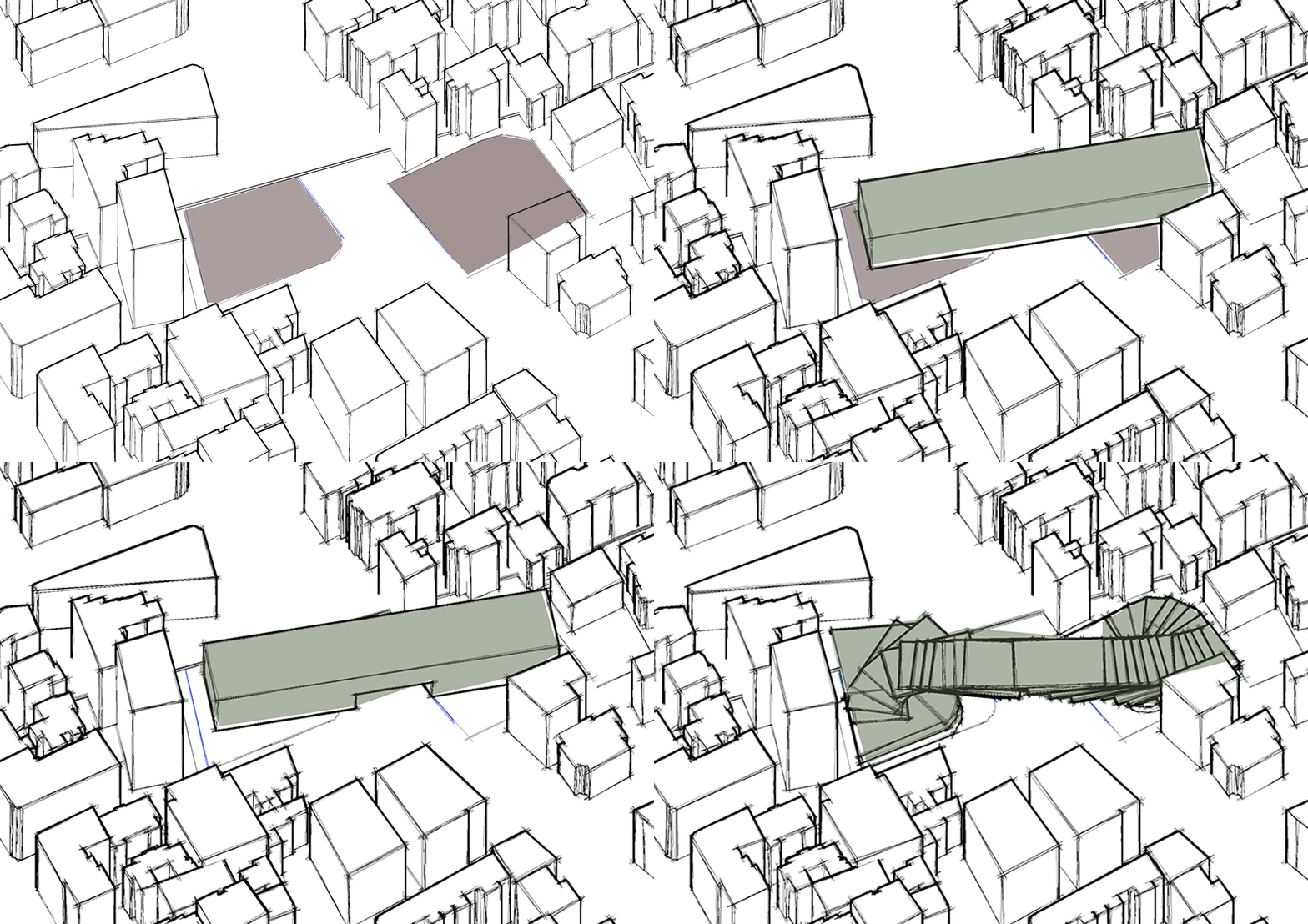


The main formal strategy that the project follows within its geometrical composition revolves around rotating platforms.
The shift of two parallel platforms creates two kinds of open spaces: one being purely public and another open space that might be used for the functions inhabiting the structure.
The rotation of these platforms on site follows the different elements of the surrounding. For the Chiah side: the ground floor is mainly directed towards the facing garden. The second platform is directed towards the facing street. The third platform is directed towards the facing building emphasizing the observation between the two structures. Finally the last
platform consists of the bridge which is a common element between both sides.
For the Ghobeireh side the ground floor is directed towards Old Saida Road. The second platform is directed towards the nearby building while the third platform is directed towards the building located at the other side.
The different direction of the platforms are shows on the diagram below. The external steps constitutes the architectural skin which is used as an external vertical circulation while creating a public space allowing the use of the barrier or transforming it into a hidden barrier. The internal activities are reflected outside through the extension of the platforms creating a series of pavilions that attract people to go up. Moreover, the shift of the platforms makes each of them read as one entity as in order to stage the activities inside that are communicated through the transparent skin under the bridge. From another perspective, the open spaces created on the periphery of the structure communicate visually with the neighborhood.


